Why Local Manufacturing Matters: Protecting Margins and Supply Chain Speed in SA Retail
Share this post
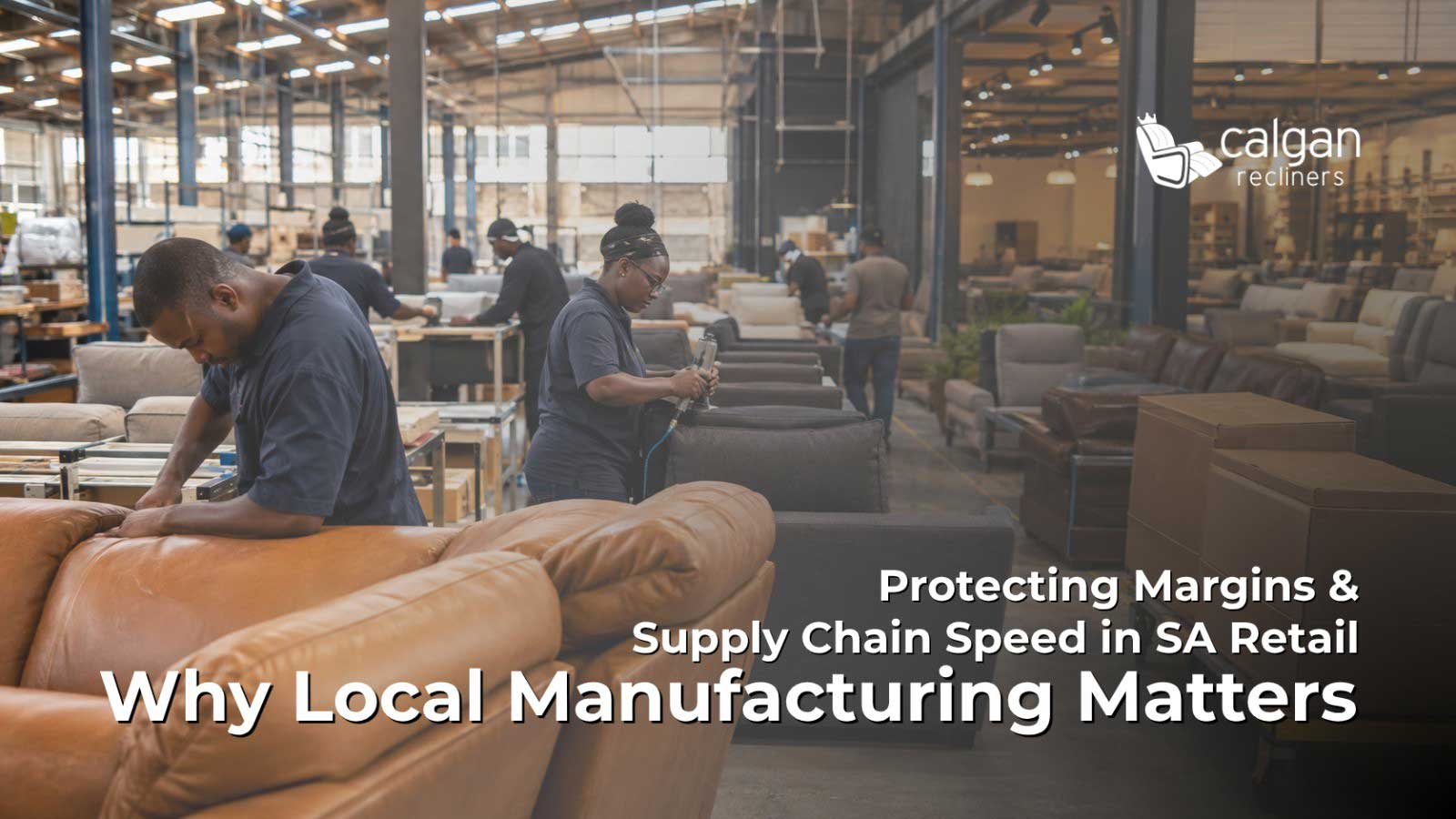
Calgan Recliners manufacturing warehouse featuring workers assembling furniture, with overlaid text reading: "Protecting Margins & Supply Chain Speed in SA Retail: Why Local Manufacturing Matters."
💡 Key Takeaway:

The lost sale is just the tip of the iceberg. When availability wavers, your sales floor loses confidence and consultants stop pitching the line.

The container that has not arrived yet

Lead time as a working capital problem

An infographic comparing a traditional imported order supply chain to a rapid local reorder loop. The top half illustrates a 3 to 5-month imported order timeline with stagnant capital, broken into five sequential steps: Deposit (Order Placed & Funds Tied Up, Day 1), Production (Manufacturing Overseas, Weeks 2–12), Shipping (Ocean Freight & Transit Time, Weeks 13–18), Port Clearance (Customs Clearance & Inspections, Weeks 19–21), and Inland Transport (Delivery to Warehouse, Weeks 22–24). The bottom half illustrates a 4-week rapid local reorder loop with a cash-to-cash cycle, broken into four steps: Reorder (Fast Local Supplier Order, Day 1), Production (Local Manufacturing, Days 2–14), Transport (Quick Local Delivery, Days 15–21), and Stock/Sell (Receive Stock & Resume Sales, Days 22–28). All text, icons, and outlines are styled in a dark brown-black color (#401e1f) against a light background.

What a stockout actually costs on the floor

The trap of ordering early

How imported stock ties up cash

Deposits, letters of credit and money standing still

Currency movement between order and arrival

Freight, duties and the landed cost nobody calculates upfront

Port delays and what they do to a trading season

Congestion and what it means for order timing

Missing a promotional window

December shutdowns and the compression they create

Margin security, not just margin percentage

Fixed rand pricing against currency exposure

Discounting to clear the wrong stock

Replacement cost against invoice cost

Detailed Graph

Speed as a floor level advantage

Reorder times measured in weeks rather than months

Filling the gap when a line runs harder than forecast

Trading from a smaller stock holding

Range flexibility and configuration

Covering choices without a container minimum

Sizing and specification changes for a customer

Short run production for contract and project work

Quality control and who carries the fault

Being able to walk the factory floor

Faults that only surface after twelve months

Spares availability and the aftersales problem

Warranty and repair economics

Compliance, standards and paperwork

Local testing and standards

Consumer Protection Act obligations

Foam, fire and material documentation

The commercial and contract side

Hospitality, healthcare and education procurement

Local content requirements in tenders

Phased delivery on large projects

Building a local and imported mix that works

Where imported volume still earns its place

Which categories reward local supply

Setting a ratio and reviewing it every season

Questions worth putting to a local manufacturer

Common questions from retail buyers

💡 Summery:

Local manufacturing is a cash flow, risk, and speed strategy. By modeling true landed costs, factoring in tied-up capital, and evaluating markdowns and warranty claims, the margin protection of local supply becomes clear.

Table of Contents

Calgan Logo
Locally Hand Crafted
Expert high-quality recliners built for South Africa
Custom Furniture Design
Customisable and available in modular options
Satisfaction Guaranteed
We use the best technology and raw materials
Nation Wide Availability
1000+ Furniture retail chains supplied in Southern Africa.
Expert Services
In-house customer service is just a phone call away